
BUILD WRITERS
WHO DON'T
NEED YOU
I give research mentors a method for teaching scientific writing, so their mentees become strong, independent writers.
If you mentor graduate students or postdocs, you know the pattern. The science is sound, but turning it into a convincing paper is the hardest part to teach, so you end up writing the paper yourself.
A convincing paper rests on three decisions: what the paper claims, why that claim matters, and which evidence backs it up. Reaching those decisions takes careful thinking. Most mentors learned that thinking slowly, by writing paper after paper until the decisions came on their own. Once the thinking becomes automatic, it's hard to notice, and that makes it hard to teach. That's why they teach the way they were taught: show a mentee a strong paper, talk through the decisions behind it, and hope the thinking sinks in. But a mentee sees the finished paper, never the moves that built it, and can't reproduce what they can't see.
My method changes that. I break the thinking into steps a mentee can follow, and I give you the examples and language to teach each one. The moves a mentee used to catch by luck become steps you can show. The thinking stays just as deep. What changes is that it now transfers to every mentee, not only the ones who would have reached the decisions anyway. Once your mentees can reach those decisions themselves, the writing comes from them, not from you.
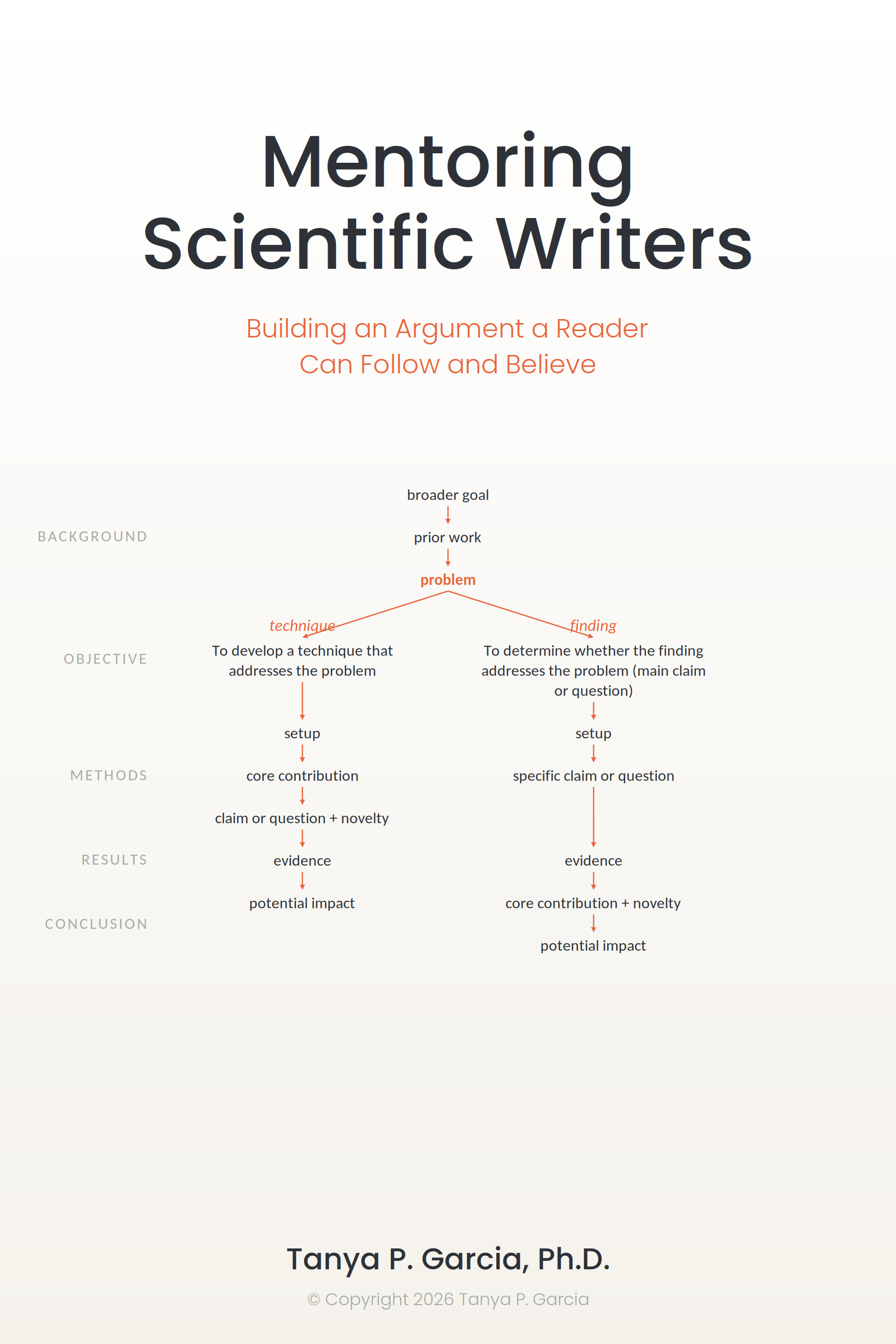
The steps take the thinking a mentee can't see and lay it out in order, each decision building on the last. From the first decision, the paper's central claim, the mentee works toward a single, convincing argument. Each step is one decision, with the reasoning behind it made visible, so the mentee decides instead of guesses.
Building that argument is one kind of decision. Putting it on the page is another, and the steps cover both. A strong argument gets a paper past review, but even a strong argument can be lost in the writing. Technical writing is easy to mistake for clear writing, and a paper dense enough will lose even the specialists it was written for. The mentee learns to write so the argument comes through: to readers in the field, who can then check the technical content, and to readers outside it, who can see why the paper matters even where the details are beyond them. Written that way, a paper doesn't just get published. It gets read, and it gets cited.
What the steps do
Ways to work together
Both are built on the same method. The difference is whether you learn to teach it on your own, or with me beside you.
The Book
The whole method, in thirteen modules, from the paper's central claim to the cover letter that gets the paper past an editor. Each module walks your mentee through the steps and hands you what you need to teach them: the assignment, a worked example, and the language for feedback that lands instead of stings. Nothing to design, nothing to invent. You open the module and teach. Work through it at your own pace, and your mentee comes out able to write the next paper without you.
The Book With Coaching
The book puts the method in your hands. Coaching is where I make sure it sticks. I've led a funded research lab since 2013, and I'm a certified coach. I know how to write work that gets funded, and how to teach someone else to do the same. With me alongside you, you learn to see what your mentee can't yet: where the argument slips, why a draft won't come together, which feedback will actually move it. I catch it, then I show you how to catch it
yourself.
Format - Twelve weeks, for you and up to three mentees, working on your real manuscripts.
Meetings- Six sessions along the way, to work the steps and refine the argument.
You bring the questions the steps raise, and I help you teach the thinking behind them. By the end, you can guide the next mentee without me, the same way your mentees learn to write without you.
Coming in 2027!